


This site is for US healthcare professionals only. Visit the patient website.
Follow us: youtube facebook

Languages:

UVADEX® (methoxsalen) Sterile Solution is indicated for extracorporeal administration with the THERAKOS® CELLEX® Photopheresis System in the palliative treatment of the skin manifestations of Cutaneous T-Cell Lymphoma (CTCL) that is unresponsive to other forms of treatment.

Clinical Profile

Clinical-profile-Small-hero-new.jpg

THERAKOS® Photopheresis delivered a meaningful response in clinical trials1 

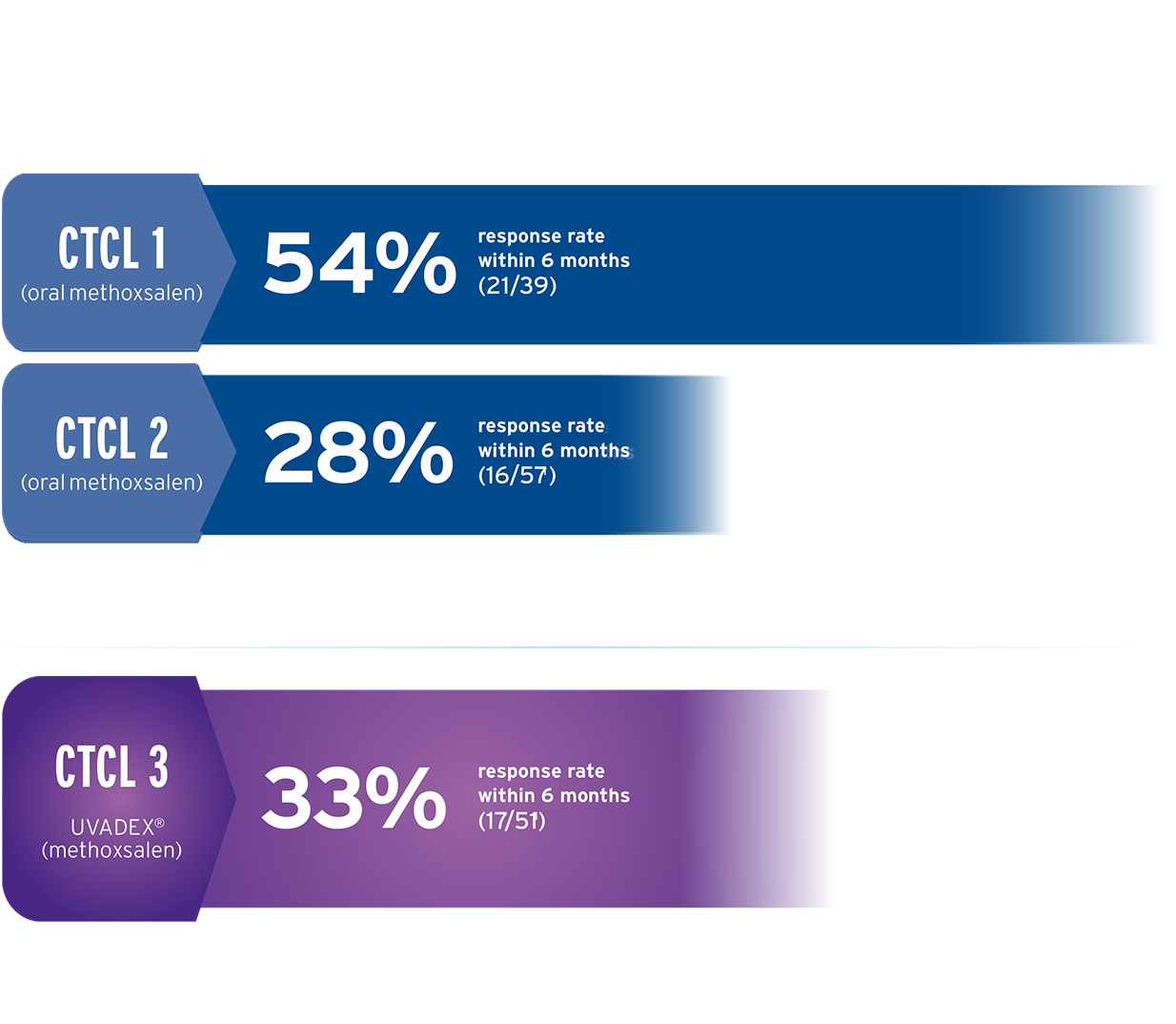
In 3 multicenter, single-arm, open-label trials, efficacy and safety were established in patients (N=147) unresponsive to skin-directed CTCL treatments, including tough-to-treat disease.1,2 

A successful treatment response was defined as a ≥25% reduction in overall skin score from baseline maintained for 4 consecutive weeks.1 

Study designs

Only patients with patch plaque, extensive plaque, and erythrodermic disease were enrolled in these studies. No patients with disease in the tumor phase were treated.1 

  • CTCL 1 permitted prednisone up to 10 mg/day in addition to topical steroids1

  • CTCL 2 was a 5-year post approval follow-up to evaluate long-term safety and had no concomitant medication restriction1

  • CTCL 3, the clinical trial using UVADEX1,2,a

    • Patients had difficult-to-treat diseaseb and were on an average of 4.3 prior therapies 

    • There are no data available regarding the efficacy of UVADEX in patients with disease in the tumor phase

    • Patients were only permitted to use topical steroids for the treatment of fissures on the soles of the feet and palms of the hands (all other steroids, topical or systemic, were prohibited)

In CTCL 3:

  • Of the 17 responses, 15 were observed within 6 months and 2 after 6 months1

  • Clinical experience does not extend beyond this treatment duration, and there is no evidence to show that treatment with UVADEX beyond 6 months, or using a different schedule, provided additional benefit1


warning-icon.svgParticipants were not required to have blood involvement to qualify for the trials, nor were they screened for it if they met inclusion criteria based on another positive criterion.15,26
CTCL-Graphic-03.png

Given the chronic nature of ctcl skin symptoms, safety and tolerability are important considerations when choosing treatments3,4

THERAKOS® Photopheresis has been in the market for 35 years with an established safety profile3,1 

  • Adverse events (AEs) in clinical trials were primarily related to hypotension secondary to changes in ECV (>1%)

  • In the UVADEX® (methoxsalen) clinical trial CTCL 3 (N=51):

    • 6 serious cardiovascular AEs (5 unrelated to Photopheresis) were reported in 5 patients (10%)

    • 6 infections were also reported in 5 patients

      • 2 were Hickman catheter infections in 1 patient

      • 4 infections were not related to Photopheresis

  • Adverse reactions reported from postmarketing experience included nausea, dysgeusia, photosensitivity reaction, pyrexia, and hypersensitivity reactions, including anaphylaxis and rash

warning-icon.svgPracticing proper infection control is critical to mitigating the potential for infection.
HCP-Patient-treatment-text-2.jpg

ECP is recommended by the NCCN Guidelines® as a treatment option for certain patients with CTCL4

References:
1. UVADEX® (methoxsalen) Sterile Solution [prescribing information]. Therakos, Inc. 16. Smith SI, Brodbelt JS. Rapid characterization of cross-links, mono-adducts, and non-covalent binding of psoralens to deoxyoligonucleotides by LC-UV/ESI-MS and IRMPD mass spectrometry. Analyst. 2010;135(5):943-952. doi:10.1039/b924023c 2. Data on File – Ref-05182. Therakos LLC. 3. Knobler R, Arenberger P, Arun A, et al. European dermatology forum—updated guidelines on the use of extracorporeal photopheresis 2020—part 1. J Eur Acad Dermatol Venereol. 2020;34(12):2693-2716. doi:10.1111/jdv.16890 4. Referenced with permission from the NCCN Clinical Practice Guidelines in Oncology (NCCN Guidelines®) for Primary Cutaneous Lymphomas V.3.2025. © National Comprehensive Cancer Network, Inc. 2025. All rights reserved. Accessed August 26, 2025. To view the most recent and complete version of the guideline, go online to NCCN.org. 15. UVADEX® (methoxsalen) Sterile Solution [prescribing information]. Therakos, Inc.  26. Data on File – Ref-05182. Therakos LLC.

TKS-25-04816 updated 12/2025

INDICATIONS AND USAGE

UVADEX® (methoxsalen) Sterile Solution is indicated for extracorporeal administration with the THERAKOS® CELLEX® Photopheresis System in the palliative treatment of the skin manifestations of Cutaneous T-Cell Lymphoma (CTCL) that is unresponsive to other forms of treatment.

IMPORTANT SAFETY INFORMATION

CAUTION: READ THE THERAKOS® CELLEX® PHOTOPHERESIS SYSTEM’S OPERATOR’S MANUAL PRIOR TO PRESCRIBING OR DISPENSING THIS MEDICATION.

UVADEX (methoxsalen) Sterile Solution should be used only by physicians who have special competence in the diagnosis and treatment of cutaneous T-cell lymphoma and who have special training and experience in the THERAKOS CELLEX Photopheresis System. Please consult the CELLEX Operator's Manual before using this product.

CONTRAINDICATIONS

UVADEX is contraindicated in:

  • Patients exhibiting idiosyncratic or hypersensitivity reactions to methoxsalen, other psoralen compounds, or any of the excipients
  • Patients possessing a specific history of a light-sensitive disease state, including lupus erythematosus, porphyria cutanea tarda, erythropoietic protoporphyria, variegate porphyria, xeroderma pigmentosum, and albinism
  • Patients with aphakia because of significantly increased risk of retinal damage
  • Patients that have contraindications to the photopheresis procedure

WARNINGS AND PRECAUTIONS

  • Patients who are receiving concomitant therapy (either topically or systemically) with known photosensitizing agents such as anthralin, coal tar or coal tar derivatives, griseofulvin, phenothiazines, nalidixic acid, halogenated salicylanilides (bacteriostatic soaps), sulfonamides, tetracyclines, thiazides, and certain organic staining dyes such as methylene blue, toluidine blue, rose bengal, and methyl orange may be at greater risk for photosensitivity reactions with UVADEX
  • Oral administration of methoxsalen followed by cutaneous UVA exposure (PUVA therapy) is carcinogenic. Methoxsalen also causes DNA damage, interstrand cross-links and errors in DNA repair
  • Methoxsalen may cause fetal harm when given to a pregnant woman. Women of childbearing potential should be advised to avoid becoming pregnant.  If UVADEX is used during pregnancy, or if the patient becomes pregnant while receiving UVADEX, the patient should be apprised of the potential hazard to the fetus 
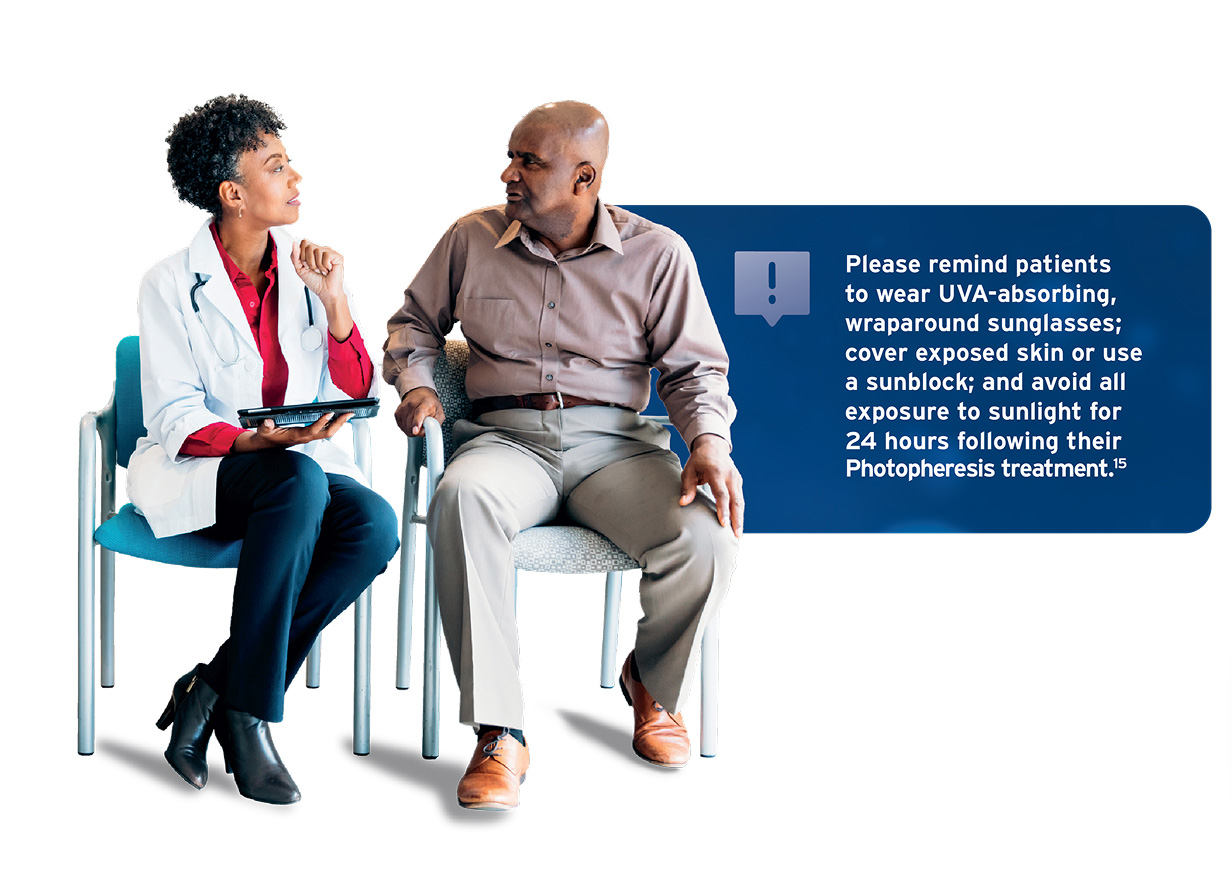
  • Severe photosensitivity can occur in patients treated with UVADEX. Advise patients to wear UVA absorbing, wrap-around sunglasses and cover exposed skin or use a sunblock (SPF 15 or higher), and avoid all exposure to sunlight for twenty-four (24) hours following photopheresis treatment
  • After methoxsalen administration, exposure to sunlight and/or ultraviolet radiation may result in "premature aging" of the skin
  • Since oral psoralens may increase the risk of skin cancers, monitor closely those patients who exhibit multiple basal cell carcinomas or who have a history of basal cell carcinomas
  • Serious burns from either UVA or sunlight (even through window glass) can result if the recommended dosage of methoxsalen is exceeded or precautions are not followed
  • Exposure to large doses of UVA light causes cataracts in animals. Oral methoxsalen exacerbates this toxicity
  • Safety in children has not been established
  • Thromboembolic events, such as pulmonary embolism and deep vein thrombosis, have been reported with UVADEX administration through photopheresis systems for treatment of patients with graft-versus-host disease, a disease for which UVADEX is not approved

ADVERSE REACTIONS

  • Side effects of photopheresis (UVADEX used with the THERAKOS Photopheresis Systems) were primarily related to hypotension secondary to changes in extracorporeal volume (>1%)

For the THERAKOS® CELLEX® Photopheresis Procedure:
INDICATIONS
The THERAKOS CELLEX Photopheresis System is indicated for use in the ultraviolet-A (UVA) irradiation, in the presence of the photoactive drug 8-methoxypsoralen (8-MOP), of extracorporeally circulating leukocyte-enriched blood, in the palliative treatment of the skin manifestations of cutaneous T-cell lymphoma (CTCL), in persons who have not been responsive to other forms of treatment.

IMPORTANT SAFETY INFORMATION
CONTRAINDICATIONS
The THERAKOS CELLEX Photopheresis System is not designated, sold, or intended for use except as indicated.

Certain underlying medical conditions contraindicate THERAKOS Photopheresis, including patients:

  • who cannot tolerate extracorporeal volume loss during the leukocyte-enrichment phase
  • exhibiting idiosyncratic or hypersensitivity reactions to 8-methoxypsoralen/psoralen compounds
  • with coagulation disorders
  • who have had previous splenectomy

WARNINGS AND PRECAUTIONS

  • THERAKOS Photopheresis treatments should always be performed in locations where standard medical emergency equipment is available. Volume replacement fluids and/or volume expanders should be readily available throughout the procedure
  • Patients who may not be able to tolerate the fluid changes associated with extracorporeal photopheresis should be monitored carefully
  • Procedures, such as renal dialysis, which might cause significant fluid changes (and expose the patient to additional anticoagulation) should not be performed on the same day as extracorporeal photopheresis
  • Individual patients may require a heparin dosage that varies from the recommended dose to prevent post-treatment bleeding or clotting during a treatment

ADVERSE REACTIONS

  • Hypotension may occur during any treatment involving extracorporeal circulation. Closely monitor the patient during the entire treatment for hypotension
  • Transient pyretic reactions, 37.7-38.9°C (100-102°F), have been observed in some patients within six to eight hours of reinfusion of the photoactivated leukocyte-enriched blood. A temporary increase in erythroderma may accompany the pyretic reaction
  • Treatment frequency exceeding labeling recommendations may result in anemia
  • Venous access carries a small risk of infection and pain

Please see accompanying Full Prescribing Information, including the BOXED WARNING for UVADEX, and see the THERAKOS Photopheresis System Operator’s Manual.


IMPORTANT SAFETY INFORMATION
chevron-up chevron-down

CAUTION: READ THE THERAKOS® CELLEX® PHOTOPHERESIS SYSTEM’S OPERATOR’S MANUAL PRIOR TO PRESCRIBING OR DISPENSING THIS MEDICATION.

UVADEX (methoxsalen) Sterile Solution should be used only by physicians who have special competence in the diagnosis and treatment of cutaneous T-cell lymphoma and who have special training and experience in the THERAKOS CELLEX Photopheresis System. Please consult the CELLEX Operator's Manual before using this product.